IF YOU FALL OFF THE WAGON
If you’ve had a drink during Sober October, you may be wondering what happens now.
Have I ruined it? Do I start again? Is there any point carrying on?
Perhaps it was one drink. Perhaps it became an evening. Perhaps you’ve found yourself returning to a pattern you wanted to change.
Whatever happened, it deserves an honest look. But one drink, one evening or one setback does not have to become a reason to abandon everything you started.
What can you learn from it? And what will you choose to do next?
LISTEN TO MY AUDIO CHAPTER ON FALLING OFF THE WAGON FREE
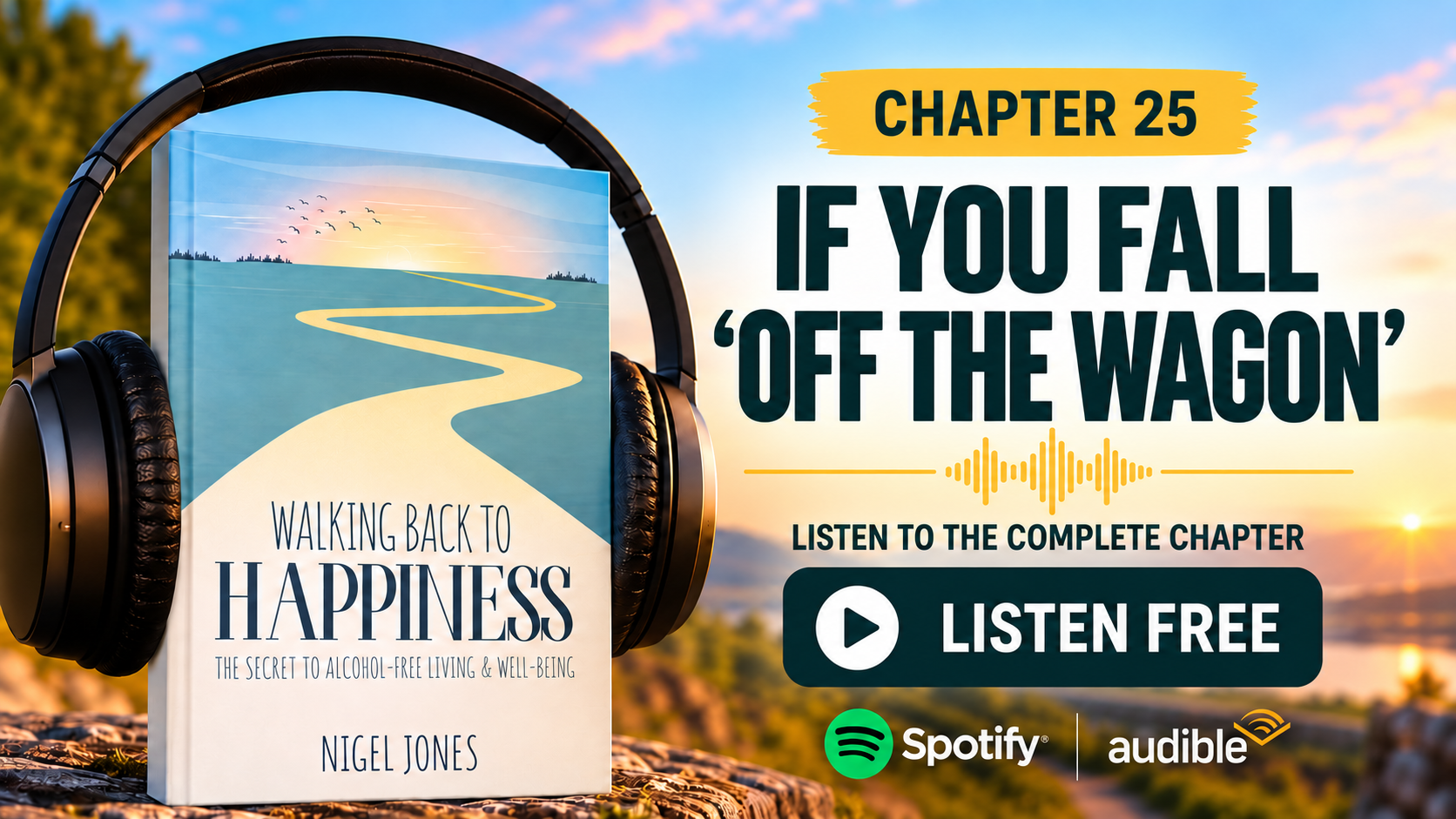
If You Fall Off the Wagon is Chapter 25 of my book, Walking Back to Happiness – The Secret to Alcohol-Free Living & Well-Being.
For Sober October, I’m making the full audiobook chapter available to listen to free.
LISTEN FREE: CHAPTER 25 — IF YOU FALL OFF THE WAGON
https://www.9kmby9am.com/books/free-audio-chapters/
You can also listen to the previously released chapters Cravings & Willpower, The Habit Loop and The Mirage of Moderation on the same page.
SIX DAYS WAS MY LIMIT
Over 35 years of drinking, the longest I stayed on the wagon was six days. I tried hundreds of times to jump back on, but always ended up drinking again. So I know what it’s like to keep trying.
What is worth understanding is both how you left the wagon in the first place and how you can get back on.
THE FOUR WAYS TO LEAVE THE WAGON
At first glance, there seem to be four ways to leave the wagon. You can jump off, fall off, get pulled off or be pushed off.
JUMPING OFF
You decide to drink. You might have been thinking about it for a while, or you might make the decision in the moment. Other people may influence you, but you make the choice.
FALLING OFF
In the book, I describe this as getting too close to the edge. Perhaps you put yourself in a situation where you already wanted a drink, without deciding how you would handle it.
That is worth recognising when you prepare for a similar situation again.
BEING PULLED OFF
Friends who are drinking encourage you to join them. Or you find yourself responding to the wider message that drinking is how we relax, celebrate and enjoy ourselves. “Go on. Just have one.” If that influenced you, it is useful to understand how.
BEING PUSHED OFF
Someone who stopped alongside you decides to drink again. This can happen when a couple take a break together and one person changes their mind. Their decision can influence yours. I was fortunate that my wife didn’t drink, so I didn’t have that particular pressure at home.
Looking at these four possibilities led me back to my own response. Whatever influenced me, taking responsibility for my decision gave me something I could work with.
You can recognise that without calling yourself weak or treating yourself as a failure.
The question becomes: what would help me respond differently next time?
THE WAGON IS MOVING
A wagon has wheels. It moves. If it were standing still, jumping on and off might be straightforward. Once it is moving, getting back on becomes a different proposition.
That is the assumption worth examining: if I decide to drink again, can I be certain I will find it easy to stop again? My own experience of repeatedly trying to get beyond six days gave me plenty of reason to question that.
If you want to return to being alcohol-free, take that intention seriously. You can begin making your plan now.
THREE STEPS YOU CAN DO
If you are planning to jump off the wagon, or have already jumped, here are three things you can do.
STEP ONE — GET BACK ON
If your intention is to be alcohol-free, return to it. Call it what you want. A new Day One or a continuation of where you got to before you left. It does not matter.
Be honest about having had a drink. Keep what you learnt from the days before it.
If you discovered that you enjoyed your alcohol-free mornings, that discovery is still yours. If you found a way to enjoy a social occasion without drinking, you can use that experience again.
A counter can restart. Your experience doesn’t disappear.
STEP TWO — FOLLOW THE METHOD
Revisit the things that helped you stop in the first place.
Why did you want to become alcohol-free? What were you hoping would change? Which books helped you understand your relationship with alcohol differently?
For me, my reasons included my health and my relationships with my wife, children and mother.
I wanted to be a healthy, calm, caring, family-orientated person. Being alcohol-free supported those values.
Those reasons would still matter if I had a drink.
Look, too, at what you expected alcohol to give you in that moment. Then consider what you could put in place before a similar situation happens again.
That might mean telling someone your plan, deciding what you will drink before you arrive, or arranging support for an evening you expect to find difficult.
STEP THREE — SLAM THE DOOR SHUT
I imagined a room inside the wagon. I stepped inside, closed and locked the door, and threw away the key.
For me, that image represents making a clear decision to stay alcohol-free. I also picture myself up front, driving the wagon. I want to decide where I am going.
You can begin by deciding how you will respond to the next invitation or difficult moment. What will you say if someone offers you a drink? What is your own plan if your partner decides to drink? Who could you contact if you need support? Make those decisions before the situation arrives.
THREE QUESTIONS TO ASK YOURSELF
If you’ve had a drink after deciding to stop, ask yourself:
- What happened before I drank, and what was I expecting alcohol to do for me?
- Why did I want to be alcohol-free, and do those reasons still matter?
- What is one thing I can do differently when a similar situation comes up?
Write down your answers.
You may discover something about the situation you were in, the support you needed or a belief about alcohol you still need to examine. Use what you learn to decide your next step.
FREE SOBER OCTOBER RESOURCES
I’ve also created a dedicated Sober October Resources page with a free printable 31-Day Calendar, practical tips, free audiobook chapters and additional support to help you through the month.
https://www.9kmby9am.com/coaching/soberoctober/
MY SIXTH SOBER OCTOBER
This is my sixth October alcohol-free, having stopped drinking in December 2020.
As a Community Champion for Alcohol Change UK, I’ve also created a Walking Back to Happiness Sober October team.
And remember, it is never too late to take on the Sober October challenge.
You can join the Walking Back to Happiness Sober October team for Alcohol Change UK here:
JOIN THE WALKING BACK TO HAPPINESS SOBER OCTOBER TEAM OR DONATE
https://www.soberoctober.org.uk/teams/walking-back-to-happiness
WALKING BACK TO HAPPINESS
Walking Back to Happiness – The Secret to Alcohol-Free Living & Well-Being is based on my own experience of changing a 35-year relationship with alcohol.
The book explores why we drink, the habits and beliefs that can keep alcohol in place, cravings and willpower, moderation, mindfulness, exercise, purpose and what can happen when alcohol stops being such an important part of life.
The complete unabridged audiobook is now available on Spotify, Audible and across major audiobook and library platforms.
LISTEN ON SPOTIFY
https://open.spotify.com/show/0ZexsLV4yWY6hMwhCiDN1E
AUDIOBOOKS
https://www.9kmby9am.com/books/audiobooks/
The book is also available in paperback, hardback and Kindle.
ALCOHOL-FREE COACHING
Alongside Walking Back to Happiness, I work one-to-one with people who want to change their relationship with alcohol and become alcohol-free.
My coaching combines life coaching, NLP, hypnotherapy and practical behaviour-change techniques, focusing on the habits, beliefs and patterns that can keep alcohol in place.
I also offer a structured 28-day Alcohol-Free Coaching Programme, with four one-to-one sessions designed to help people understand what is driving their drinking, manage cravings and triggers, change their thinking around alcohol and build a sustainable alcohol-free future. Coaching is available online and face-to-face.
Find out more about Alcohol-Free Coaching:
https://www.9kmby9am.com/coaching/alcohol-free-coaching/
If you think you may be physically dependent on alcohol, suddenly stopping can be dangerous. Speak to your GP or an appropriate alcohol service for advice about reducing or stopping safely.
LINKS
Website — https://www.9kmby9am.com/
Email — nigel@9kmby9am.com
Coaching — https://www.9kmby9am.com/coaching/
Alcohol-Free Coaching — https://www.9kmby9am.com/coaching/alcohol-free-coaching/
Testimonials — https://www.9kmby9am.com/coaching/coaching-testimonials/
Newsletter — https://www.9kmby9am.com/latest-news/newsletter/
Free Audio Chapters — https://www.9kmby9am.com/books/free-audio-chapters/
Sober October Resources — https://www.9kmby9am.com/coaching/soberoctober/
Sober October Team — https://www.soberoctober.org.uk/teams/walking-back-to-happiness
Spotify — https://open.spotify.com/show/0ZexsLV4yWY6hMwhCiDN1E
#SoberOctober #AlcoholFree #WalkingBackToHappiness #AlcoholChangeUK #IfYouFallOffTheWagon #SoberCurious #9KMby9AM
Back to latest articles